I got an email from another white Hindu who was a bit concerned about this movie that's just come out.
Would the character flirting with Indian philosophy as part of her three-country tour reflect badly on the rest of us non-Indian Hindus. Would it reignite the idea of us not being serious about it?
The subject of the movie, based on a memoir, is a woman in her mid-thirties, who has a crisis in her life and goes out into the world to find peace. She goes to Italy, then India, then Bali in search of a happy life.
I went to see this movie with my mother this past weekend and I was very pleasantly surprised.
I enjoyed it very much and it seemed to open my heart back up to the joy of the search for meaning. The most powerful moment for me was when she was getting ready to leave India (where she had been living in an ashram) and she summed up her experience there by saying she had learned that "God dwells in you, as you." This image you have of what a spiritual person looks like isn't a real person. You are not the silent, ethereal, angel floating around being nauseatingly spiritual all the time. That's not God. God is you exactly as you are (the person we imagine we should be is Ingrid Bergman in The Bells Of St. Mary, as the character says).
That spoke to me deeply. I feel I have been going through some similar issues to what this woman was dealing with. It seemed as though she was addressing me directly. She was working to find the balance between being spiritual and enjoying life.
I am always trying to be my vision of what a spiritual or enlightened person should look like and it is exhausting.
I was so inspired by the movie that I went the next day to buy the book. I'm more than half way through it now and it is astoundingly good. I've underlined almost every page and I want to just quote the entire thing for you!
I highly recommend it. She has wonderful and very insightful descriptions of meditation. She tells it like it is, as a real person, discovering her soul for the first time.
One thing that is not so clear in the movie is that she has been practicing Hinduism for two years before she arrives at that ashram. India is not just a random stopover for her in the midst of a world tour, it is deeply personal and meaningful.
I know the guru that she speaks of. I'm familiar with that school, though she doesn't name it. She is still a devote of that guru as far as I can tell. I doubt that she labels herself as a Hindu, but she certainly practices advaita and practices it with great sincerity. It may be that she is beyond the need for labels, while I am not yet. I know that someday I will need to let go of the label and be universal, but right now I really need the label of "Hindu."
In fact, the author has more claim than I to Hinduism in some ways, since she actually went to India and lived at the ashram for four months.
And so I think that Ms. Elizabeth Gilbert fits into our rag-tag little group. If she ever stumbled upon this blog, I would welcome her heartily as another American, non-Indian Hindu. I would give her a guest aarti and feed her chai and chaat.
Inspired by the book, I plan to do a few different posts on subjects that she made me reflect on, such as how prayer works, cherry-picking religion, and how we are imperfect and perfect at once.
I feel better than I've felt in months, refreshed with energy to tackle my meditation again, and to look for a mantra that suits me better. It's cliche to say, but these last months have been very dark for me. I didn't ever lose faith or my beliefs, but I did distance myself from God and from those beliefs as I dealt with the grief and rage of losing a dear friend. I can feel myself starting to find my way back, though, back to the traditions and practices that will heal me. I thank Elizabeth Gilbert for her book because she really showed how spiritual practices work for a real person, not just a monk or a holy person.
Monday, August 23, 2010


Saturday, August 21, 2010
I know where I'll be celebrating!
I thought I was going to be doing Krishna Janamashtami alone at home.
But today I got an invitation through my Hindi meet-up group to go to the Hare Krishna temple for the celebration.
I'm really excited. I'm so happy to have somewhere to go and there will even be at least a few familiar faces there.
But today I got an invitation through my Hindi meet-up group to go to the Hare Krishna temple for the celebration.
I'm really excited. I'm so happy to have somewhere to go and there will even be at least a few familiar faces there.
Tuesday, August 17, 2010
Holiday: Krishna Janmashtami
We are about to head into the Hindu holiday season. Although there are holidays all year round, a lot of major ones happen in the Fall, leading up to and culminating with Diwali.
September 2nd this year is Krishna's birthday.

Let me tell those who don't know a little about Krishna's background.
Birth
Krishna was born more than 3,000 years before Christ in Mathura. His mother was a princess named Devaki and his father was her husband, Vasudeva. Her brother, Kansa, had wrongfully imprisoned their father, the king, and seized the throne.
But there was a prophesy that Devaki's eighth child would kill Kansa. So Kansa had his sister and brother-in-law imprisoned also and each time she had a child, Kansa would murder it (except the seventh child escaped). When Devaki gave birth to the eighth child, Vasudeva managed to carry baby Krishna out of the prison, through a rainstorm and across a raging river (all this with the help of various gods) and brought Krishna to the village of Gokula where he was exchanged with a baby girl there and Krishna was raised by his foster parents, Yashoda and Nanda. The girl child was brought back to the prison where Kansa attempted to kill her, but she became an angel.
Years later, Krishna does come back to fulfill the prophecy and kill his evil uncle. Another interesting part of the story is that many believe that Krishna was conceived without sexual union, again much like the stories about Jesus that came thousands of years later.
Childhood
Krishna and his foster family moved to Vrindavana nearby (all these places are in Uttar Pradesh)

Krishna was known as a mischievous child. He loved butter and would often find ways to steal it from the butter pots of the women in the village. They would try to put them up high, but Krishna always found a way. He got the nickname the Makhan Chor, meaning The Butter Thief.

At various times Krishna showed his specialness. He killed demons, for example. Also, his mother discovered some strange qualities of his. When he was being naughty, Yashoda attempted to tie him to a tree, but found that even though he was a small child, no rope was long enough to tie him. Once she found him eating sand and she pried open his mouth to get the grit out, but found that she could see the entire universe in the back of his throat.
Teenage
As a teenager he herded cows and played a flute. Gopis (milk maids) adored him and vied for his attention. In particular, he had a close relationship with one named Radha.
Much love poetry is written about Krishna at this age.

Later Life
As a young man Krishna returned to his place of birth to kill his evil Uncle and reinstate his grandfather as king. He continued to live in the palace and at this time befriended the Pandava brothers.
Krishna takes on an important role in the Mahabharata, where he is the spiritual advisor to the Pandavas, particularly Arjuna. It is within the Mahabharata that Krishna teaches Arjuna the lessons that are called the Bhagavad Gita, the song of the Lord.

Death
There is disagreement about Krishna's death. According to Vyasa's telling of the Mahabharata, Krishna retired to the forest to meditate for the rest of his days and ascended into heaven. However, according to another telling of the Mahabharata, while Krishna was in the forest meditating, a hunter mistook his foot for an animal and shot and killed him.
Either way, Krishna's disappearance/death marks the transition of the world into the final age, the Kali Yuga.
Different people are drawn to different stages of Krishna's life and worship different aspects of him.
To celebrate the birthday one fasts the day before and stays up all night to observe the time when Krishna was born at midnight. At that time a statue of baby Krishna is bathed, clothed, and placed in a cradle, and aarti is performed (worship with light).
Women often paint footprints in rice powder outside their homes at dawn, indicating Krishna entering his foster home.
Many places put on plays, or lilas, about the life of Krishna. In some areas young men form huge human pyramids to knock down jars of butter that are suspended high in the air.

 credit
(all of these beautiful paintings are all over Google images and I can't seem to figure out where they originated and whose work they are, but each one, if clicked, will take you to the website where I found it) Update: Apparently, they belong to ISKON and that is not really a surprise! So, thanks to ISKON and its members for these beautiful works of art.
September 2nd this year is Krishna's birthday.

Let me tell those who don't know a little about Krishna's background.
Birth
Krishna was born more than 3,000 years before Christ in Mathura. His mother was a princess named Devaki and his father was her husband, Vasudeva. Her brother, Kansa, had wrongfully imprisoned their father, the king, and seized the throne.
But there was a prophesy that Devaki's eighth child would kill Kansa. So Kansa had his sister and brother-in-law imprisoned also and each time she had a child, Kansa would murder it (except the seventh child escaped). When Devaki gave birth to the eighth child, Vasudeva managed to carry baby Krishna out of the prison, through a rainstorm and across a raging river (all this with the help of various gods) and brought Krishna to the village of Gokula where he was exchanged with a baby girl there and Krishna was raised by his foster parents, Yashoda and Nanda. The girl child was brought back to the prison where Kansa attempted to kill her, but she became an angel.
Years later, Krishna does come back to fulfill the prophecy and kill his evil uncle. Another interesting part of the story is that many believe that Krishna was conceived without sexual union, again much like the stories about Jesus that came thousands of years later.
Childhood
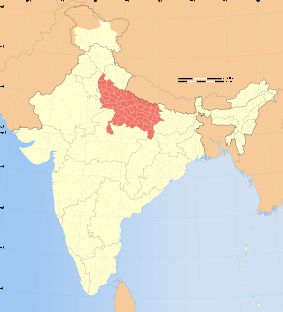
Krishna and his foster family moved to Vrindavana nearby (all these places are in Uttar Pradesh)
Krishna was known as a mischievous child. He loved butter and would often find ways to steal it from the butter pots of the women in the village. They would try to put them up high, but Krishna always found a way. He got the nickname the Makhan Chor, meaning The Butter Thief.
At various times Krishna showed his specialness. He killed demons, for example. Also, his mother discovered some strange qualities of his. When he was being naughty, Yashoda attempted to tie him to a tree, but found that even though he was a small child, no rope was long enough to tie him. Once she found him eating sand and she pried open his mouth to get the grit out, but found that she could see the entire universe in the back of his throat.
Teenage
As a teenager he herded cows and played a flute. Gopis (milk maids) adored him and vied for his attention. In particular, he had a close relationship with one named Radha.
Much love poetry is written about Krishna at this age.

Later Life
As a young man Krishna returned to his place of birth to kill his evil Uncle and reinstate his grandfather as king. He continued to live in the palace and at this time befriended the Pandava brothers.
Krishna takes on an important role in the Mahabharata, where he is the spiritual advisor to the Pandavas, particularly Arjuna. It is within the Mahabharata that Krishna teaches Arjuna the lessons that are called the Bhagavad Gita, the song of the Lord.

Death
There is disagreement about Krishna's death. According to Vyasa's telling of the Mahabharata, Krishna retired to the forest to meditate for the rest of his days and ascended into heaven. However, according to another telling of the Mahabharata, while Krishna was in the forest meditating, a hunter mistook his foot for an animal and shot and killed him.
Either way, Krishna's disappearance/death marks the transition of the world into the final age, the Kali Yuga.
Different people are drawn to different stages of Krishna's life and worship different aspects of him.
To celebrate the birthday one fasts the day before and stays up all night to observe the time when Krishna was born at midnight. At that time a statue of baby Krishna is bathed, clothed, and placed in a cradle, and aarti is performed (worship with light).
Women often paint footprints in rice powder outside their homes at dawn, indicating Krishna entering his foster home.
Many places put on plays, or lilas, about the life of Krishna. In some areas young men form huge human pyramids to knock down jars of butter that are suspended high in the air.

 credit
(all of these beautiful paintings are all over Google images and I can't seem to figure out where they originated and whose work they are, but each one, if clicked, will take you to the website where I found it) Update: Apparently, they belong to ISKON and that is not really a surprise! So, thanks to ISKON and its members for these beautiful works of art.
Lucky
Once again I find parallels between converts in different religions. I've mentioned this blog before, it is one written by a convert to Judaism. Right now Judaism is struggling with some law issues that might make it possible to revoke a person's conversion.
http://www.alizahausman.net/2010/08/imagining-day-they-come-to-take-your.html
Two things stood out to me in that quote. The first is the phrase "lucky enough to have been born Jewish."
I think this is a common feeling in converts. We think, if only we had learned this wonderful religion from the start, how much pain and trouble it would have saved us!
We might feel frustrated that those who were born into it don't appreciate it enough or realize what a treasure they have.
But what we often don't realize is that we needed that pain and trouble to get where we are today. It was part of our soul's journey to struggle to find a path that gives us peace. We are lucky in our own way, to have the opportunity to explore all the options and to find the way that we are completely sure of.
When I was a kid, growing up in a spiritual organization, some of the adults who had found it later in life used to tell me how lucky I was to have been born into it. "You won't have to make the same mistakes I made," they told me.
I found that it was a tremendous pressure to always be perfect and to follow the path they gave me because they told me it was the best, not because I knew it for myself.
I also discovered that I had to make mistakes. We don't get through life without making mistakes. That is a huge part of how we learn things.
Sometimes I think my life would be easier if I had been born fully Hindu and sometimes I think that I might not have loved it as much as I do if that were the case.
That is, of course, not to say that born Hindus can't love and appreciate their religion. But I think many of the born Hindus who love their religion have thought carefully about it and examined it. Who knows if I had been born Hindu if I would have done that? I'm very glad that I did and so I don't think that I would change my path even if I could. I have learned so much just because of starting as an outsider and working my way in.
The other thing that I like in this quote is the way of seeing everyone in the Jewish faith as family. I think this is true of Hinduism too. If we see all Hindus as part of the family we can see how we would be diminished by leaving anyone out. The variety and debate are some of the things that make Hinduism great. Diversity of thought keeps our minds sharp and keeps us always questioning so that we don't become complacent in our knowledge.
On an administrative note, I will start to delete comments that I find hateful or offensive. If there is a point that you would like to make that might be considered angry or hateful, please email it to me and I will decide whether to discuss the issue or make a post related to it.
I see these people who are lucky enough to have been born Jewish repeat over and over again that what affects converts ultimately affects the entire Jewish people, not just converts and their immediate family because the entire Jewish people IS a family. What happens to one Jew affects all Jews. It is a quick step from making the everyday lives of converts and potential converts miserable to making the lives of every Jew (born Jewish or not) miserable and making anyone and everyone's Judaism suspect.
http://www.alizahausman.net/2010/08/imagining-day-they-come-to-take-your.html
Two things stood out to me in that quote. The first is the phrase "lucky enough to have been born Jewish."
I think this is a common feeling in converts. We think, if only we had learned this wonderful religion from the start, how much pain and trouble it would have saved us!
We might feel frustrated that those who were born into it don't appreciate it enough or realize what a treasure they have.
But what we often don't realize is that we needed that pain and trouble to get where we are today. It was part of our soul's journey to struggle to find a path that gives us peace. We are lucky in our own way, to have the opportunity to explore all the options and to find the way that we are completely sure of.
When I was a kid, growing up in a spiritual organization, some of the adults who had found it later in life used to tell me how lucky I was to have been born into it. "You won't have to make the same mistakes I made," they told me.
I found that it was a tremendous pressure to always be perfect and to follow the path they gave me because they told me it was the best, not because I knew it for myself.
I also discovered that I had to make mistakes. We don't get through life without making mistakes. That is a huge part of how we learn things.
Sometimes I think my life would be easier if I had been born fully Hindu and sometimes I think that I might not have loved it as much as I do if that were the case.
That is, of course, not to say that born Hindus can't love and appreciate their religion. But I think many of the born Hindus who love their religion have thought carefully about it and examined it. Who knows if I had been born Hindu if I would have done that? I'm very glad that I did and so I don't think that I would change my path even if I could. I have learned so much just because of starting as an outsider and working my way in.
The other thing that I like in this quote is the way of seeing everyone in the Jewish faith as family. I think this is true of Hinduism too. If we see all Hindus as part of the family we can see how we would be diminished by leaving anyone out. The variety and debate are some of the things that make Hinduism great. Diversity of thought keeps our minds sharp and keeps us always questioning so that we don't become complacent in our knowledge.
On an administrative note, I will start to delete comments that I find hateful or offensive. If there is a point that you would like to make that might be considered angry or hateful, please email it to me and I will decide whether to discuss the issue or make a post related to it.
Sunday, August 15, 2010
Happy Independence Day!


Images from:
http://www.nydailynews.com/news/galleries/indian_day_parade/indian_day_parade.html
http://newshopper.sulekha.com/india-s-independence-day_photo_302978.htm
http://www.zabrigraphics.com/graphics/act,photos/cid,3165/
http://nonzie.com/orkut-scraps/august-events/independence-day-graphics/
Thursday, August 12, 2010
Hindi Slow Down
I've run low on the energy it takes to study a new language every day. My progress now is so slight that I feel crushed by the weight of how much I don't know.
I am able to read and understand somewhat as long as it is simple material (Tintin movies, Teach Yourself Hindi book, Krishna comic books). Every time I try to write or speak, it comes out so grammatically wrong that people can't understand me.
I think the reason this happens is that when you are reading or hearing something, you can get the gist of it without understanding all the little parts. When producing the language, you have to know which postposition to use and what order to put the words in, and it's just a lot more to know.
I've been taking a bit of a break from it, trying to recharge my batteries, as it were. I've signed up for a class starting in mid-September at the Washington Language Institute. They offer nine levels of Hindi classes, and I signed up for the second level, since I already know the alphabet and the basics of the language. This should help me to start actually speaking and give more structure to my learning.
Being really good at a foreign language is remarkably difficult. For me, anyway. And being able to understand is great, but it isn't good enough. If I want to raise bilingual children, then I need to be able to speak the language and speak it correctly.
I am completely worn out from the effort.
My heart is unsettled
Surya sent us this link of images of the devastating floods in Leh:
http://expressbuzz.com/photogallery/leh-aftermath-of-floods/879.html
It is so hard for me to hear about and look at images of people in pain. I hate feeling helpless.
Anyone have ideas about what we could do to relieve some of the suffering there?
http://expressbuzz.com/photogallery/leh-aftermath-of-floods/879.html
It is so hard for me to hear about and look at images of people in pain. I hate feeling helpless.
Anyone have ideas about what we could do to relieve some of the suffering there?
Subscribe to:
Posts (Atom)