Even though I have been surrounded by Indian philosophy all my life, I am very new to the culture. Six years ago I started Bharatnatyam classes and found myself spending a lot of time around Indians and absolutely loving it.
At that time the only thing I knew about Bollywood was that people make fun of it. I had heard that the movies were long and overly dramatic and Americans I knew who had seen them rolled their eyes about them. But I was curious to see for myself, so I asked the girls in my dance class to recommend a first one to see.
They suggested Dil Se. I don't agree that it makes a good intro! It's very intense and very dark, and of course very long. I felt thrown in the deep end with that one. I would like to rewatch it now, since it's been several years and I've gotten a much better feel for Bollywood movies.
Now the term "Bollywood" refers to Hindi films being produced in Mumbai. There are also films in Marathi, in Tamil, and in many other Indian languages and those have their own following and are called other things. There are also movies known as "cross over." Those are movies that are either more Western in style or are filmed in the West. Mira Nair's movies are usually called cross-over (she did Monsoon Wedding and The Namesake).
I had seen Monsoon Wedding when it was in theaters, but that is far from a Bollywood style.
If people ask me now how they should get started with Bollywood movies, I recommend Swades.
I saw that one very early on too, long before I knew that the main actor in both Swades and Dil Se is one of the most popular heartthrobs, named Shahrukh Khan or SRK. I had no idea at all.
Of course, when I first saw Swades, I pronounced it "Sway-deez," which is pretty much the way that combination of letters would be pronounced in English. It wasn't until I watched it again recently and saw the title in devanagari letters in the opening that I realized it was "swah-desh" And from that I was able to understand what the title meant! This is a perfect example of why it is a mistake to write Indian languages in Roman script. :)
Swades is a good introduction because the story is easy to follow, it starts out in America so it's a good grounding for Americans trying to get into it, and the music is well integrated into the story.
After that, there are a lot of directions you could go. There are tragic epics like Dil Se or Raincoat (these aren't really my style, and I never ended up finishing watching Raincoat!), there are loads of romantic comedies like Kuch Naa Kaho, there are classics from the the 1950s like Pyaasa (which I have not seen) and Madhumati (apparently responsible for starting to spread the idea of reincarnation to the West), there are gangster movies and there are buddy comedies like 3 Idiots that came out earlier this year and I haven't been able to see yet.
The 1970s was, apparently, when the term "Bollywood" was coined, as India overtook America as the largest film producer in the world. There has been a lot of borrowing back and forth between Hindi cinema and American movies. Though probably more of a cross-over movie, Bride and Prejudice was a brilliant adaptation of Jane Austen's Pride and Prejudice to modern India. And going the other way, the director of Moulin Rouge said he was directly inspired by Bollywood.
Music has also had a great sharing between India and America. Both filmi music (the music in Hindi movies) and Bhangra have influenced American hip-hop and vice versa.
There have been some Indian style movies written and produced in other places with various degrees of success. Slumdog Millionaire was written, directed and produced in Britain, but was based on a book by an Indian author. Marigold was a 2007 attempt done in Hollywood. I watched it recently and found it fell flat, though I can't really put my finger on why. One fantastic attempt was a Direct TV miniseries called Bollywood Hero. It stars Chris Kattan playing himself. He's frustrated that no one takes him seriously in Hollywood and he stumbles onto an opportunity to be a leading man in India, so he takes off for adventures in creating a Bollywood movie. It's very funny and it's available from Netflix.
Netflix is a great source of Hindi movies. Much more so than Blockbuster and I switched from Blockbuster to Netflix for that reason. I found that once I got the feel for it, I loved the music and dance and the long stories.
Wednesday, July 21, 2010


Sunday, July 18, 2010
One Family
The White Indian Housewife has an interesting post up about feeling inferior.
Here is a little clip:
This is not a topic I feel much of an expert on, but I was interested to read her experiences and I would like to read the book she mentioned.
One thing that it did make me think of is my feeling lately that I'm not doing enough to help the world.
I also believe, as she says, that we are all creations of the same God, that we are all family. (As a matter of fact, a friend sent me this link recently and it is a short story that beautifully illustrates a possible why and how we are all One. It's passable writing and an amazing story. It's very short, you should go read it!)
I hear stories about people living in such poverty and having so little, worrying over having enough to eat, and I feel sad and I feel guilty. I want to do something to help, but it's so hard to know what or how.
I look for opportunities to volunteer, but too often volunteering seems like something I am supposed to do just to feel good about myself. "Come for this tour and do some volunteering on the side." The volunteering to play games with kids or teach some English doesn't seem like it gets at the core of what I want to help with.
So I'm trying something new while I continue to look for opportunities. I found out about Kiva.org from a friend's Facebook page. It's an organization that connects people through small loans. I can loan $25 to a third-world business of my choosing and a bunch of other people will also contribute to that business. When the business owner pays back the loan, you can put the money toward another loan. (And there is a group for Hindus, http://www.kiva.org/team/kiva_hindus ) So, that's one step I can take while I brainstorm other ways to help the world.
What other ways do you think we have to contribute to the lives of our brothers and sisters around the world?
Here is a little clip:
The way I see it, there is no superior or inferior culture. We are all people…. all the same creations of God (and if you believe in reincarnation, we can be born into any culture and have probably existed in other cultures). But I do wonder where these views come from?
What exactly do Indians have to feel inferior about and why? They are resilient, hardworking, intelligent, and adaptable people.
Are us whites to blame? I don’t think so.
This is not a topic I feel much of an expert on, but I was interested to read her experiences and I would like to read the book she mentioned.
One thing that it did make me think of is my feeling lately that I'm not doing enough to help the world.
I also believe, as she says, that we are all creations of the same God, that we are all family. (As a matter of fact, a friend sent me this link recently and it is a short story that beautifully illustrates a possible why and how we are all One. It's passable writing and an amazing story. It's very short, you should go read it!)
I hear stories about people living in such poverty and having so little, worrying over having enough to eat, and I feel sad and I feel guilty. I want to do something to help, but it's so hard to know what or how.
I look for opportunities to volunteer, but too often volunteering seems like something I am supposed to do just to feel good about myself. "Come for this tour and do some volunteering on the side." The volunteering to play games with kids or teach some English doesn't seem like it gets at the core of what I want to help with.
So I'm trying something new while I continue to look for opportunities. I found out about Kiva.org from a friend's Facebook page. It's an organization that connects people through small loans. I can loan $25 to a third-world business of my choosing and a bunch of other people will also contribute to that business. When the business owner pays back the loan, you can put the money toward another loan. (And there is a group for Hindus, http://www.kiva.org/team/kiva_hindus ) So, that's one step I can take while I brainstorm other ways to help the world.
What other ways do you think we have to contribute to the lives of our brothers and sisters around the world?
Friday, July 16, 2010
Hindi in unexpected places
I didn't know that a post praising peace would be controversial. I'm sorry, I didn't intend to get people riled up. Obviously, these are my personal opinions and they may or may not be valid or grounded in reality, but you come here for my beliefs and here they are!
Anyway, something light for today.
When I was at work yesterday I happened to glance at some engineering magazine that someone had brought in. It was laying face down so that I saw the ad on the back and I was so excited that I tore the back cover off and took it home with me:

That is Hindi! It says "Do you speak Matlab?" The best part is that I knew what it said immediately, instinctively, without even closely examining it. I just knew it. Just like that. What an incredible feeling. It is a very simple sentence, of course, but I take whatever little victories I can in language learning.
******************************************************
For sometime in the future I've asked my father to write a post for this blog. It will probably be a while because I did not give him a deadline, he's a very busy person. But I wanted to offer his perspective because, unlike me, he sees no difficulty at all in blending Advaita with Christianity. He also feels no conflict between being a spiritual man and being a scientist. I think he has a really great perspective that I would love to share with you all.
Independence Day
I can see that my last post touched a nerve, but I stand by my statements. There is nothing more powerful than holding on to your courage and dignity while refusing to stoop to the level of your enemy. It forces your enemy to see his own base and ugly actions. The less violent you are, the more the world respects you and takes your side.
Resistance to adharma? Absolutely. That's why the word "resistance" is in the phrase "peaceful resistance." This is not about being a coward or a wimp. It is about looking the enemy in the eye and refusing to treat him as badly as he treats you. It makes you the better person. It is about getting up again and again and again and looking straight at him without giving him the satisfaction of striking back.
We've seen that work in our country as well and it is the way that civil rights were won. I'm sorry that it has been a difficult road for India, my heart aches for the pain of the British occupation, but peaceful resistance is the only thing that brought that to an end.
Hinduism is not a religion free from violence. Unlike Christianity, there is actually support for the idea of a holy war. But a holy war is not to be taken on lightly, it is for very rare circumstances. The key to a holy war is the purity of intent.
One would fight because it is one's duty, but without anger and without desire. That was the fatal mistake of the Kauravas. The lust for power and for victory. The Pandavas fought because they had to, but they did EVERYTHING possible to prevent the war. Krishna's first instruction in the Gita is to act without lusting for the fruits of the action. That is a tremendously difficult thing to do.
(I would say that holy war is not possible in the kali-yuga, but I think personally that World War II proved that wrong. It may have been a nasty war, but it was a necessary one. Circumstances like that do not come along very often.)
August 15th is India's Independence Day. It is a time to be tremendously proud. Victory was won by refusing to be victims and refusing to give the enemy the satisfaction of behaving like the less civilized people they thought you were. What a mistake that was.
It was a long and difficult journey to win independence and the struggle goes on for India to find its footing in the world. But it is happening. It is not an easy thing to do, remember that America fought a bitter civil war within 100 years of its independence.
Here is the famous speech given by India's first Prime Minister, Jawaharlal Nehru, on the eve of independence:
Long years ago we made a tryst with destiny, and now the time comes when we shall redeem our pledge, not wholly or in full measure, but very substantially. At the stroke of the midnight hour, when the world sleeps, India will awake to life and freedom. A moment comes, which comes but rarely in history, when we step out from the old to the new, when an age ends, and when the soul of a nation, long suppressed, finds utterance. It is fitting that at this solemn moment we take the pledge of dedication to the service of India and her people and to the still larger cause of humanity.
At the dawn of history India started on her unending quest, and trackless centuries are filled with her striving and the grandeur of her success and her failures. Through good and ill fortune alike she has never lost sight of that quest or forgotten the ideals which gave her strength. We end today a period of ill fortune and India discovers herself again. The achievement we celebrate today is but a step, an opening of opportunity, to the greater triumphs and achievements that await us. Are we brave enough and wise enough to grasp this opportunity and accept the challenge of the future?
Freedom and power bring responsibility. The responsibility rests upon this Assembly, a sovereign body representing the sovereign people of India. Before the birth of freedom we have endured all the pains of labour and our hearts are heavy with the memory of this sorrow. Some of those pains continue even now. Nevertheless, the past is over and it is the future that beckons to us now.
That future is not one of ease or resting but of incessant striving so that we may fulfil the pledges we have so often taken and the one we shall take today. The service of India means the service of the millions who suffer. It means the ending of poverty and ignorance and disease and inequality of opportunity. The ambition of the greatest man of our generation has been to wipe every tear from every eye. That may be beyond us, but as long as there are tears and suffering, so long our work will not be over.
And so we have to labour and to work, and work hard, to give reality to our dreams. Those dreams are for India, but they are also for the world, for all the nations and peoples are too closely knit together today for any one of them to imagine that it can live apart Peace has been said to be indivisible; so is freedom, so is prosperity now, and so also is disaster in this One World that can no longer be split into isolated fragments.
To the people of India, whose representatives we are, we make an appeal to join us with faith and confidence in this great adventure. This is no time for petty and destructive criticism, no time for ill-will or blaming others. We have to build the noble mansion of free India where all her children may dwell.
The appointed day has come-the day appointed by destiny-and India stands forth again, after long slumber and struggle, awake, vital, free and independent. The past clings on to us still in some measure and we have to do much before we redeem the pledges we have so often taken. Yet the turning-point is past, and history begins anew for us, the history which we shall live and act and others will write about.
It is a fateful moment for us in India, for all Asia and for the world. A new star rises, the star of freedom in the East, a new hope comes into being, a vision long cherished materializes. May the star never set and that hope never be betrayed!
We rejoice in that freedom, even though clouds surround us, and many of our people are sorrowstricken and difficult problems encompass us. But freedom brings responsibilities and burdens and we have to face them in the spirit of a free and disciplined people.
On this day our first thoughts go to the architect of this freedom, the Father of our Nation [Gandhi], who, embodying the old spirit of India, held aloft the torch of freedom and lighted up the darkness that surrounded us. We have often been unworthy followers of his and have strayed from his message, but not only we but succeeding generations will remember this message and bear the imprint in their hearts of this great son of India, magnificent in his faith and strength and courage and humility. We shall never allow that torch of freedom to be blown out, however high the wind or stormy the tempest.
Our next thoughts must be of the unknown volunteers and soldiers of freedom who, without praise or reward, have served India even unto death.
We think also of our brothers and sisters who have been cut off from us by political boundaries and who unhappily cannot share at present in the freedom that has come. They are of us and will remain of us whatever may happen, and we shall be sharers in their good and ill fortune alike.
The future beckons to us. Whither do we go and what shall be our endeavour? To bring freedom and opportunity to the common man, to the peasants and workers of India; to fight and end poverty and ignorance and disease; to build up a prosperous, democratic and progressive nation, and to create social, economic and political institutions which will ensure justice and fullness of life to every man and woman.
We have hard work ahead. There is no resting for any one of us till we redeem our pledge in full, till we make all the people of India what destiny intended them to be. We are citizens of a great country on the verge of bold advance, and we have to live up to that high standard. All of us, to whatever religion we may belong, are equally the children of India with equal rights, privileges and obligations. We cannot encourage communalism or narrow-mindedness, for no nation can be great whose people are narrow in thought or in action.
To the nations and peoples of the world we send greetings and pledge ourselves to cooperate with them in furthering peace, freedom and democracy.
And to India, our much-loved motherland, the ancient, the eternal and the ever-new, we pay our reverent homage and we bind ourselves afresh to her service.
Jai Hind!
Thursday, July 15, 2010
Peaceful Resistance
I know an Indian man who thinks that India is too passive and too weak. It saddens him that India has been taken over so many times but has never taken over anyone else. He sees this as a fundamental flaw that holds India back from greatness.
I see it as a fundamental greatness.
But we have different measuring sticks. There are different kinds of successes to have in the world. One kind is to be a super power nation and take money and resources from lesser powers. But a definition of success that is so rooted in the world can only be temporary. As the saying goes: "You can't take it with you."
Look at the sage Yajnavalkya. He had a good, cushy life, but it felt empty to him. He decided to give up his material goods and go in search of a truth that does not die. He decided to divide his property among his two wives, but Maitreyi asked him whether wealth would make her immortal. He told her it would not. She said that she wanted whatever it was that he was giving up his wealth for. Whatever was so great that it would bring immortality. And so he took her with him.
To me, success is how peaceful you can be, how calm you can be, how well you can train and control your mind, your desires, your lusts.
In the west, we almost think of Gandhi as a God. His name is held in reverence as the absolute example of goodness. It seems that he is not as universally worshiped in India. I think people are somewhat more aware of his humanness, of his flaws. And certainly, he left a very difficult situation in his wake. It's impossible to know how things would have played out if he had not been murdered.
The problems associated with separating India and Pakistan were not his doing, though it became what seemed like the only solution. Gandhi really wanted everyone to be able to get along, for Hindus and Muslims to live in peace with one another. That dream is still a ways off.
But his methods did work. And he inspired all the greatest leaders of our times. Martin Luther King, Jr. and Nelson Mandela for example. The unwavering conviction and dedication to peace is an unstoppable force. People may die in the process, but the vibration of goodness does not leave the world.
I found this article through Andrew Rosenthal, the same man who wrote the article about Jesus as an Ishta-Devata. He shared this on Facebook and it seems to me to describe really well just how effective peaceful resistance can be. When you are in a fight with someone, you want the rest of the world to see that you are the victim and to support you in wanting to take down the other side. It's very hard to get sympathy from anyone if you are cruel in the same way that the other side is cruel. Notice the part about the women refusing to move. It rerouted the Israeli army!
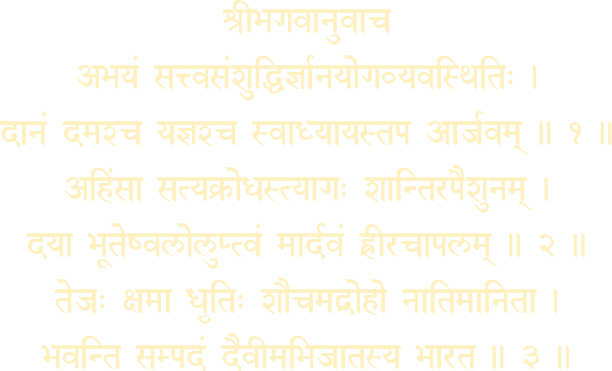
If you live striving to treat all others as yourself and to follow the principles laid out in Chapter 16, then consider yourself a success!
Bhagavad Gita, Chapter 16, Opening:
Lord Krishna said: Fearlessness, purity of the inner psyche, perseverance in the yoga of Self-knowledge, charity, sense-restraint, sacrifice, study of the scriptures, austerity, honesty; nonviolence, truthfulness, absence of anger, renunciation, equanimity, abstinence from malicious talk, compassion for all creatures, freedom from greed, gentleness, modesty, absence of fickleness, splendor, forgiveness, fortitude, cleanliness, absence of malice, and absence of pride-- these are some of the qualities of those endowed with divine virtues, O Arjuna. (16.01-03) Quoted from the translation here.
Wednesday, July 14, 2010
Comedy
I am running low on ideas, I feel like I'm repeating myself!
Chinmaya has let out for the summer and I have been so busy with work and school that I haven't been doing as much reading on religion as I usually do.
So, if you have any questions, thoughts, or ideas, do send them my way.
******************
A couple nights ago my boyfriend downloaded an Indian Comedy Tour from Netflix and it was a little disappointing. I only found one of the five comics funny and one of them was so-so.
Here is a clip where some of the best stuff from that show was blended together:
The only comic not represented on that was a girl named Dahlia McPhee who was half Indian and only told one Indian joke.
I went to YouTube because I figured that there must be some funny Indian comics. My boyfriend told me to look up Russel Peters. I don't know how he came to have that name, but he is Indian and he is very funny.
Here are a few clips:
(Although, I have to say that I love the Indian accents)
Anyway, there's lots more!
Tuesday, July 13, 2010
Hmmm... Latin, best I can do.
असतो मा सद्गमय ।
तमसो मा ज्योतिर्गमय ।।
मृत्योर्मामृतं गमय ।
Asato ma saad gamaya
Tamaso ma jotir gamaya
mritur ma amritang gamaya
(I really dislike writing Indian languages in Roman alphabet, I think it looks weird and ugly, but there's no other way for me to explain how it sounds.)
If you look closely at my profile picture here, you will see that it is a photograph of a cross-stitch of this prayer. It is something known as a Vedic prayer. Each of the Vedas opens with a short prayer in Sanskrit and this is my favorite one.
It means:
Lead me from the unreal to the real
Lead me from the darkness to the light
Lead me from death to immortality
I have a tremendous respect for the Sanskirt language. The way I grew up, it was seen as the holy language, the language of God. We were told that the laws of the universe could be found in Sanskrit grammar. If we learned the grammar, we would know how the whole world works (it is, by the way, the most difficult grammar I have ever encountered).
Sanskrit is what led my mother to join the organization I grew up in. She loved the puzzle of it, figuring out the pieces. She translates passages from the Upanishads frequently and her dining room table is always covered with Sanskrit dictionaries and grammars and other books and papers.
Throughout my childhood I took classes in Sanskrit, but not serious ones. We would learn the letters of the alphabet, but we learned the same stuff over and over and many middle-aged people in the school just continue to practice the alphabet for years, never actually learning it. I learned enough to chant a few prayers.
In college I decided to take a Sanskrit class and that was the hardest class I've ever had! It turns out that at college level you spend the entire first year doing nothing but learning grammar rules. You don't get to translating or reading until the second year. I barely passed one semester.
I switched to studying Hindi because I wanted a language I could use to communicate. Now there are spoken Sanskrit classes, but I was not aware of such a thing at the time and I'm not sure how many people one could actually communicate with using it. Sanskrit is more or less a dead language. There are holy men who still speak it and it is experiencing a revival, but I doubt it will ever take off in popularity.
Still, all the holy books are written in Sanskrit and if you wanted to have a deeper understanding of them it is worth studying. I depend on asking my mom the deeper meaning!
Even though Hindi grew out of Sanskrit, they are not mutually intelligible, so my mom with her thirty years of Sanskrit study cannot understand Hindi and I cannot with my one year of Hindi learning understand Sanskrit. However, the alphabet is almost the same, so we can each read the other, just without understanding what we're saying.
A little about Sanskrit:
1) The "a" sound is not said like in "ant," the "ant" sound does not exist in the language, so it should sound a bit more like "Saanskrit", the "a" is more of an "uh."
2) The grammar rules were codified in the 4th century by a man named Paanini and my dad likes to make sandwich jokes about this when we go to a deli.
3) It is on the Indo-European family tree of languages. This often surprises people, but Sanskrit is related to English and other European languages and we do have words in English derived from Sanskrit.
4) An example of the complexity of the grammar. It has ten classes of verbs. These all change according to tense and aspect, etc. Verbs also have "grades" and I don't even know what that means.
5) According to tradition, Sanskrit was spoken for thousands of years before it was ever written down. Many religious people believe it to be the first language in existence.
6) Sanskrit is still used in most ceremonies at Hindu temples and at weddings. Frequently only the priest knows what it means (sort of like Latin and Catholicism).
7) Not all of the hundreds of Indian languages are related to Sanskrit at all.
So, there's a little introduction to the "language of the Gods."
(The title for this post is from a movie called PCU where a character is selling pre-written thesis papers. A kid comes in and asks for one in Sanskrit and the guy says, "Sanskrit? You're majoring in a 5,00 year old dead language? Hmmm... Latin, best I can do.")
I'm thinking pretty soon I'll do a post on the sound "Om", what it is and what it means.
Subscribe to:
Posts (Atom)